35 Nature Play Ideas for Preschool & Kindergarten
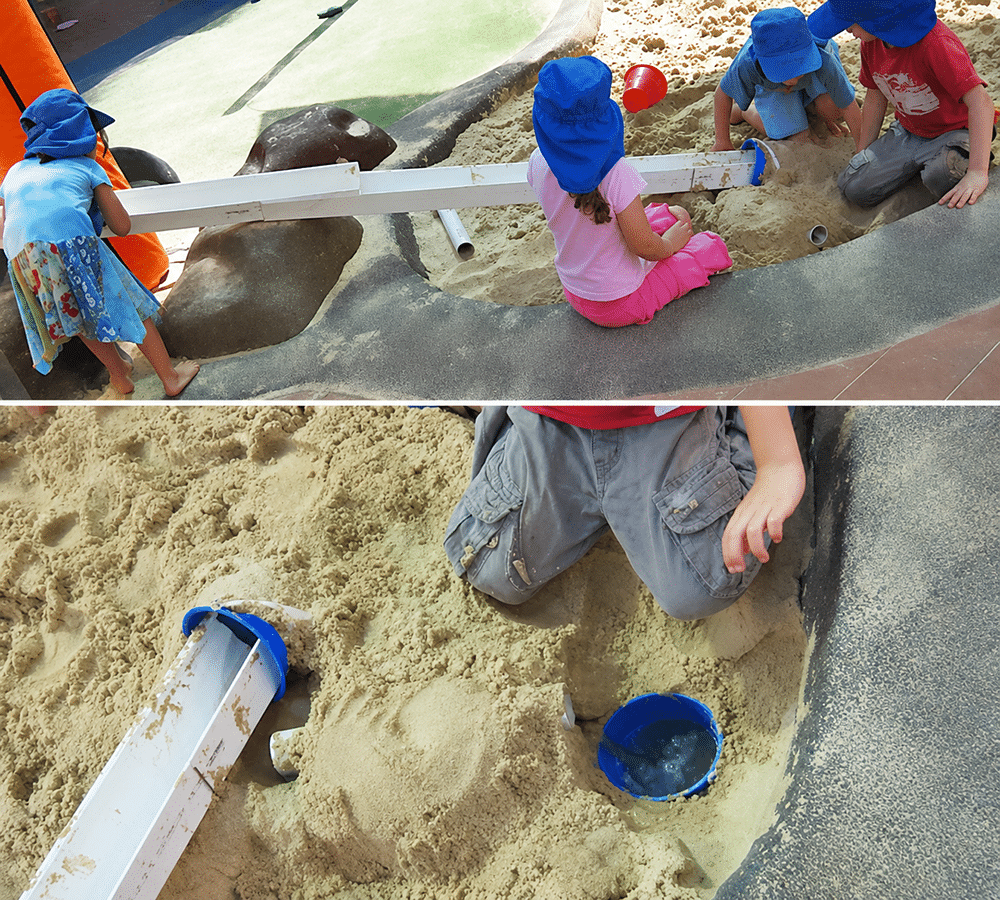
One morning in the sandpit, a small group of students became absorbed in the challenge of creating a waterfall. Armed with buckets, spades, lengths of plastic guttering and a collection of pipes and funnels, they set about designing a system that would carry water from one end of the sandpit to the other.
What began as a simple pouring activity quickly evolved into a collaborative engineering project. The students experimented with different angles, digging channels and repositioning the pipes whenever the water escaped its intended path. Each unsuccessful attempt sparked new ideas and lively discussion. “It’s going too fast!” one child observed, while another suggested placing a bucket underneath to catch the water before it overflowed.
The students worked together to solve each obstacle. They discovered that by allowing the water to collect in a bucket first, they could slow its flow and direct it through a pipe into a second container. This idea wasn’t proposed by any educator; it emerged through the student’s own observations, predictions, and experimentation. Excitedly, they tested their design again and again, making small adjustments each time to improve the flow.
Moments like these remind me why I value a student-centered approach to playful learning – the learning occurring in this moment grew directly from the students’ curiosity. My role was simply to provide open-ended materials, observe closely and support their thinking with occasional questions and encouragement.
Through their investigation, the students explored scientific concepts such as gravity, flow, and cause-and-effect, while also developing communication, cooperation, persistence and problem-solving skills. The waterfall project became a powerful example of how capable young children are when given time, space and materials to explore, create and collaborate.
The Educator’s Role
Many of the best student-led activities are often initiated by a thoughtful prompt, provocation, or experience planned by an observant educator. In the example above, the addition of plastic guttering and piping to the sandpit was a considered choice.
In a well-chosen activity, students will have the freedom to experiment, imagine and create, with the educator deciding parameters related to the play experience, such as;
- Where the play will happen
- What equipment/tools are made available
- When the play will happen and for how long
- How observed play will inform future planning
These decisions don’t detract from the play. They are the reason the play can happen. And the goal of the educator isn’t to plan the perfect activity – it’s to create opportunities for students to connect with nature, explore independently or within a social context, and develop a sense of enjoyment from spending time outdoors.
35 Nature Play Ideas for Preschool & Kindergarten
In the spirit of student-led exploration, below you’ll find 35 nature play ideas, each selected for its potential to spark curiosity, discovery and experimentation. Use them to inspire outdoor provocations within your learning environment or as a source of ideas when supporting individual students or small groups who may need encouragement to engage in outdoor play.
For ease of use, the ideas have been organised around the seven recurring motifs of student’s outdoor play identified by educator David Sobel. These themes reflect the patterns of play that naturally emerge when students have time, freedom and access to rich outdoor environments.
Maps & Pathways
- Line paths with fallen logs, large sandstone blocks, or tree cookies to challenge student’s balance as they navigate the yard.
- After exploring, have students use loose parts – such as sticks for fences, pinecones for trees, and pebbles for paths – to build a 3D map of the yard on the ground.
- Draw/write a series of pavement chalk prompts along a pathway to engage students in heavy work, which is great for body awareness and emotional regulation. Try prompts for different ways of moving, e.g moving like different kinds of animals, rocket or star jumps, march or run on the spot and walk the line.
- Take students on a touch walk to find different textures (rough bark, smooth leaves, etc). Have them draw a map and glue small samples of what they found onto the corresponding locations.
- Lay out a path that tells a story as you walk. Retell familiar stories or fairy tales like Little Red Riding Hood or Going on a Bear Hunt, placing props or story markers along the trail to guide storytelling.

Fantasy & Imagination
- Set up a play shop under a tree with seedpods, leaves and other nature finds.
- Invite students to make sand paint with different coloured sands and water. Use small branches as paint brushes and explore how the colours change as they dry.
- Provide open-ended supplies (pipes, guttering, buckets, etc) for students to explore making a river or a waterfall in the sandpit.
- Hunt for natural treasures to use to make music. Invite students to find things to tap, shake or rattle.
- Work with students to choose an area outdoors to use as a stage and then invite them to put on a performance with friends.
- Provide a collection of picture books for outdoor use. Pair related dress ups and props to encourage storytelling and story-inspired imaginative role play.
Adventure
- Take students for a walk up a big hill to look at the view. Explore the hill, taking the opportunity to roll down and run back up where possible.
- Provide balls of different sizes for free play.
- Create puddles of water for students to ride bikes or scooters through.
- Initiate a game of Shadow Tag, where students chase each others’ shadows.
- Place a series of sticks along the ground and initiate play with a game of jumping over them. Vary the interval between sticks to increase the challenge.
- Provide a collection of hula hoops outside for students to experiment with different ways to play with them.
Special Places
- Work with students to transform a tree into a castle, spaceship or pirate ship.
- Initiate a game of Hide and Seek.
- Work with students to create a special quiet space outdoors.
- Provide a variety of cubby making materials – bedsheets, rope and pegs one day versus large, recycled cardboard boxes on another.

Hunting & Gathering
- Invite students to mix up some mud with soil or sand and water for mud pizzas! Decorate them with loose parts.
- Challenge students to find three things that are smaller than their thumb.
- Invite students to lay still on the grass, close their eyes and listen closely. Make a list of all the different sounds they can hear.
- Create nature bracelets by loosely wrapping a strip of masking tape around each child’s wrist (sticky-side out) for attaching nature finds on a nature walk. Flowers, leaves and grasses work especially well.
- Take students on a colour hunt, encouraging them to collect as many different colours as they can. Once back in the classroom, students can mix paints to match the colour of their favourite find.
- Head off on a scent hunt – finding items in nature that smell nice and that don’t!
Small World Play
- Provide natural loose parts for students to create small worlds, such as a home for a magical fairy, a cave for a fierce dragon or a nest for a small bird.
- Provide a collection of figurines for students to use outside in play.
- Add homemade playdough to a collection of interesting natural loose parts for exploring textures. This works especially well in a tuff tray outdoors.
- Plan and host a teddy bears picnic with students.
Animal Allies
- Provide magnifying glasses for students to explore an outdoor space up close. Discuss the difference between living and non-living finds.
- Make a small pile of stones and sticks outdoors where it won’t be interrupted. Invite students to regularly check the space to see if any backyard minibeasts have made themselves at home.
- Encourage students to look closely at an ant, snail, earthworm or slater, sharing questions that arise from their observation. E.g. How does it move? How does it eat? (If students are finding it hard to find insects, they can try carefully flipping over a small to medium-sized rock sitting on a patch of soil). Use their responses as prompts for further investigation.
- Take a bird watching walk, trying to imitate the songs of any birds heard along the way.

Why not start with just one simple invitation to explore the outdoors and see where your students’ curiosity leads? A stick may transform into a wand, a fallen log into a balance beam, and a sandpit into an entire world of discovery!