How Children Play Outside…When Adults Don’t Get in the Way!
American educator and author David Sobel has spent decades observing how children naturally interact with the outdoors. Through his work in place-based and environmental education, he recognised that when children are given time, freedom and access to natural spaces, patterns of play emerge again and again.
Sobel called these recurring patterns play motifs, with a total of seven motifs representing the ways children instinctively explore, make sense of and build relationships with the natural world.
For educators, these motifs provide a valuable lens for observing children’s interests and designing outdoor environments that encourage curiosity, experimentation, and child-led learning.
Unpacking Sobel’s Seven Play Motifs
A framework for observation
When reading through the list below, keep in mind that children rarely engage with just one motif at a time. A child building a cubby may also be collecting sticks (Hunting and Gathering), inventing a story (Fantasy and Imagination) and pretending it is an animal’s home (Animal Allies). Rather than treating Sobel’s motifs as separate activities, think of the following seven play patterns as overlapping ways children investigate, imagine and connect with the natural world.
1. Special Places
Many children are instinctively drawn to finding or creating their own special places within the outdoor environment. Whether it’s a cubby beneath a low tree branch, a space behind a fallen log or a hideaway made in a small space between bushes, these special places provide opportunities for quiet reflection, imaginative play, collaboration and a growing sense of belonging. As children create and return to these spaces, they develop confidence, independence and a meaningful connection with their outdoor environment.
Support this play by:
- Providing long sticks, branches, logs, fabric, pegs and other loose parts for children to build shelters and cubbies.
- Planting shrubs, climbers or tall grasses to create natural nooks and secluded spaces.
- Looking at your outdoor environment from a child’s perspective. Get down low and notice where children are naturally drawn to hide, gather or play. Use this information to inform your observations and learning programmes.
- Allowing children to adapt and revisit their special places over time, rather than packing them away at the end of each session.

2. Hunting & Gathering
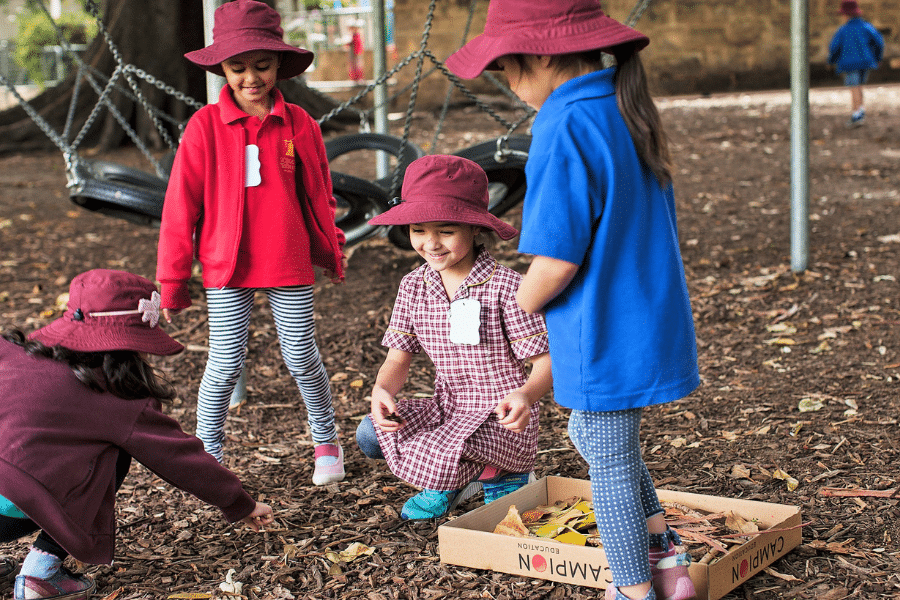
For many children, collecting natural treasures is an irresistible part of outdoor play. Whether they are searching for smooth stones, colourful leaves or spiky seed pods, children are observing, comparing, sorting and making sense of their environment. These treasured collections can become a wonderful starting point for conversations, investigations, creative projects and imaginative play.
Support this play by:
- Encouraging children to search for natural treasures during outdoor play.
- Providing baskets, buckets or jars for collections.
- Inviting children to sort, classify, count or display their collections.
- Building a shared collection of natural loose parts for ongoing construction, art and dramatic play.
3. Small Worlds
Creating miniature worlds encourages children to combine natural loose parts in creative ways as they build, problem-solve and tell stories. Small world play encourages imaginative and creative thinking while helping children explore ideas about relationships, place and belonging. When educators slow down and observe these carefully constructed worlds, they often gain valuable insights into children’s thinking, interests and understanding.
Support this play by:
- Providing small figurines, vehicles, animals and natural loose parts for children to combine in open-ended ways.
- Leaving patches of long grass, rocks, logs and garden beds for children to transform into miniature habitats.
- Offering slices of wood, bark, seed pods, pebbles and sticks as building materials.
- Where possible, allowing children’s creations to remain in place so they can revisit and extend their ideas over several days.
4. Fantasy & Imagination
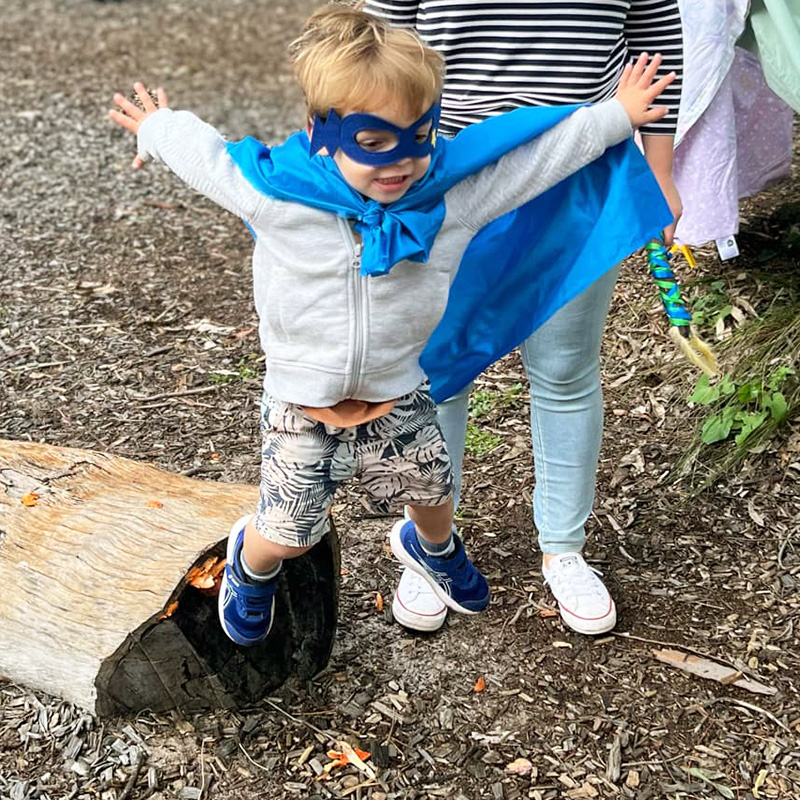
Natural environments provide endless inspiration for imaginative play. A fallen log becomes a pirate ship, a patch of bush transforms into a dinosaur world, and a collection of sticks becomes a magical forest. Through pretend play, children experiment with ideas, develop language, negotiate with others and make sense of their experiences.
Support this play by:
- Planning for flexible outdoor spaces that can be used in many different ways.
- Providing open-ended props for outdoor time such as fabric, cardboard boxes, baskets, ropes and natural loose parts.
- Including dress-ups, puppets, masks, capes, hats and simple props outdoors.
- Reading and retelling stories outside to inspire dramatic play in authentic natural settings.

5. Animal Allies
Children are naturally fascinated by animals and often develop deep empathy through observing, caring for and pretending to be all manner of creatures. These experiences help children appreciate living things, whilst also building curiosity about the natural world. Watching insects at work, listening for birds or imagining life as a kangaroo all contribute to a child’s developing understanding of other living creatures.
Support this play by:
- Providing opportunities for children to quietly observe birds, insects and other wildlife.
- Planning outdoor spaces to include habitats that attract native animals, like birds and beneficial insects.
- Including animal stories, puppets, masks, wings and tails to extend imaginative play.
- Inviting children to imitate animal movements through games and movement experiences.
6. Adventure
Adventure is about testing limits, solving problems and discovering what lies beyond the next tree or around the next corner. It encourages children to develop physical confidence while assessing risk and making decisions for themselves. For children, an invitation to go on an adventure is often far more exciting than simply going for a walk!
Support this play by:
- Planning opportunities for climbing, balancing, jumping, scrambling and exploring.
- Including natural obstacles such as logs, rocks, slopes and uneven ground where appropriate.
- Allowing children to assess manageable risks and challenge themselves.
- Following children’s curiosity when they discover something interesting rather than rushing to the next activity.
- Exploring the outdoor environment together as fellow adventurers.
7. Maps & Pathways
Children are naturally curious about where paths lead and enjoy creating routes, drawing maps and finding shortcuts between favourite places. Through this exploration they develop spatial awareness, navigation skills, and a strong sense of place.
Support this play by:
- Creating winding paths with stepping stones, logs, gravel or timber rounds.
- Encouraging children to draw maps of the playground or local environment.
- Creating simple hidden treasure trails or creating opportunities for children to design their own.
- Providing clipboards and drawing materials outdoors for children to draw their own maps or pathways.
- Exploring local parks, bushland or school grounds to strengthen children’s connection with their community and the natural world.
David Sobel reminds us that meaningful outdoor learning begins with observation. When we pay attention to the ways children naturally play in nature, we can design environments that extend their interests rather than direct them.
Instead of asking “What activity should I plan today?” perhaps the more valuable question is, “What opportunities can I create for children to follow their curiosity?” The answer may be as simple as adding loose parts beneath a tree, allowing the grass to grow a little longer or extending outdoor time to allow children to turn an ordinary corner of the playground into somewhere or something extraordinary!