7 Simple Outdoor Games to Boost Physical Health & Wellbeing
The Australian Movement Guidelines recommend that children aged 3–5 years engage in at least three hours of physical activity throughout the day, including a minimum of one hour of energetic ‘huff-and-puff’ play such as running, jumping, dancing or climbing.
One of the easiest and most enjoyable ways to help children meet these recommendations is through active outdoor play, and while free play outdoors encourages children to move, the addition of a well-chosen game can kickstart that all important huff-and-puff element essential to physical health.
Unlike highly structured sports or activities focused on rules and competition, the open-ended outdoor games featured below encourage children to adapt, imagine, solve problems and move in ways that feel natural and enjoyable. They also provide countless opportunities to develop the fundamental movement skills that underpin lifelong physical activity, including running, jumping, hopping, leaping, skipping, throwing, catching and kicking.
With a teacher providing the invitation, gentle guidance and encouragement, these playful experiences create rich opportunities for children to practise physical skills, build confidence, connect with one another and simply delight in the joy of movement.
7 Simple Outdoor Games to Boost Physical Health & Wellbeing
1. Follow the Leader Animal Walk: Played like the traditional game of Follow the Leader, the nominated leader chooses an animal (e.g. crab, kangaroo, magpie) and leads an animal walk, moving like the animal and making the noises too!
2. Make Your Own Marching Band: Challenge children to find natural objects to use as musical instruments for a marching band – think tapping or rubbing together sticks or stones, rattling pebbles in small containers, scrunching leaves, etc. Once each child has an instrument ready, line up and start marching to a regular beat. Try moving in different ways – more quickly or at a slower pace, playing instruments up high or down low, etc.
3. Balance Challenge: For this challenge you will need a small collection of natural objects, like large seedpods or gumnuts, choosing those that will balance on the palm of a child’s hand. Encourage each child to balance an object on their palm. Once steady, have them try walking forwards while it is balanced. Next, try walking backwards, then standing on one leg without letting it fall. What other body parts can they balance their object on?
4. Colour Tag: Allocate an outdoor space to play and then call out a colour name, inviting the children to run and touch an item they can see of that colour. Speed up the pacing between calls to really get children huffing!
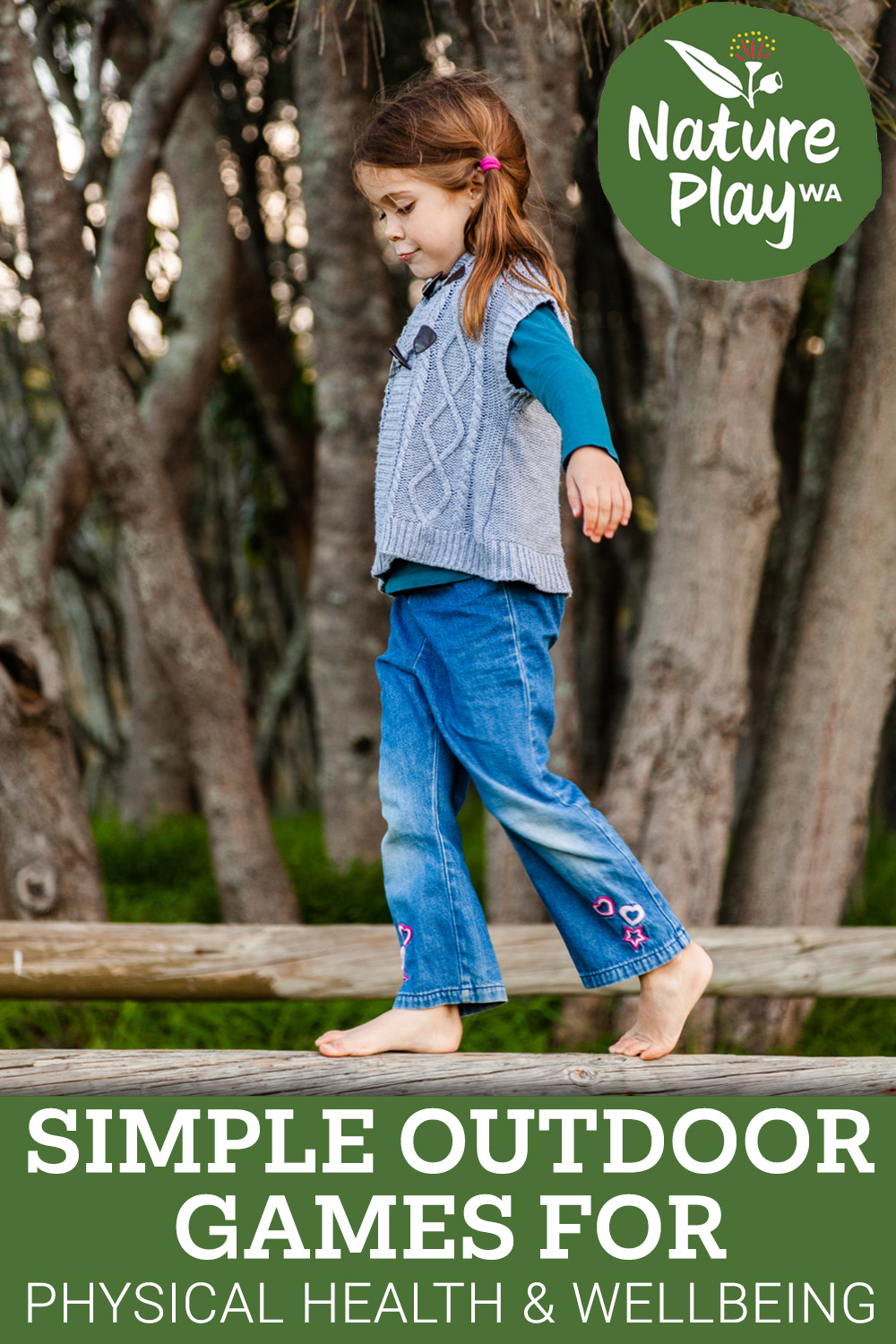
5. Walk the Line: Use pavement chalk to create a line for the children to walk along. Include sections of straight, curvy, zig zagged and dashed lines, and finish with a spiral. Pretend the line is a rope to balance upon and practise different styles of walking along it – sideways, backwards, heel-to-toe, tippy toes, etc
6. Push the Tree Over: Children find a tree (or wall) and push against it with both hands, using all their strength in an attempt to push the tree over. As well as being a recognised regulation strategy, this activity promotes strength, posture and stamina.

7. The Floor is Lava: Encourage children to work together to create a path for moving across a designated outdoor space, stepping and climbing on and over a series of obstacles, without touching the floor.
Of course, you can continue to encourage physically active play beyond outdoor games by offering a range of simple equipment during free play time. You might like to try;
- Placing hula hoops around the garden for free exploration. They are fun for hopping or jumping into, as well as spinning or chasing as they roll along.
- Setting up a series of small hurdles for leaping over.
- Placing different sized balls in an area where kids can throw, catch and kick with each other.
- Inviting children to blow and chase bubbles.
- Offering small bean bags for throwing, catching and balancing.
- Working together with children to build an obstacle course using features of the outdoor space and available equipment to balance on, climb over, crawl through/under, jump off, etc. Trees, branches, stumps, hula hoops, cones or coloured discs, cardboard boxes, masking tape, pavement chalk and lengths of rope are all useful for creating obstacles.
Whether you’re planning a dedicated outdoor learning session or simply looking to add more movement to your day, these playful games offer a simple way to keep children active while strengthening movement skills. The goal isn’t perfect technique or competition but creating enjoyable experiences that encourage every child to move with confidence, challenge themselves and discover the joy of being active.