Play and Connection: Fostering better mental health in the early years
Children’s mental health is a rather terrifying topic for parents. It feels like mental health challenges are a dark cloud that could come over our kids at any time. The discussion surrounding it can leave us feeling anxious and powerless, like there’s little we can do to protect our kids. But the truth is, there are things we can do to foster good mental health in our children—starting much earlier than we might think.
There is growing awareness and efforts across health and education to address what has been described as a mental health crisis for our kids. It seems that as a community, we are coming to realise that we can’t take mental health for granted and we need to actively support good mental health in our kids. We also need to be honest and acknowledge that this isn’t just about the kids, it’s about the systems and society that we are raising them in. We are struggling to find a balance between old approaches (education comes to mind) with new ways of living – working parents, social media, changing climates.
While these stressors undoubtedly affect children’s mental health, research is increasingly showing that many kids experience mental health issues even before they encounter school or social media or can fully express what they’re going through.
Preliminary research from ORIGINS, which is a collaboration between Joondalup Health Campus, and The Kids Research Institute Australia, found that in a cohort of over 900 three-year-olds, 47% experienced emotional lability (a rapid and intense change in emotions or mood, typically inappropriate to the setting) and 35% experienced anxiety. It’s worth repeating – 35% of the three-year-olds were experiencing anxiety and almost half were struggling with their emotions (outside of the typical emotional roller coaster that three-year-olds experience).

Our solution for 3-5 year olds
In response to this data and the alarming trends in poor early childhood mental health, my organisation, Nature Play WA, partnered with ORIGINS to develop a program to help address this issue. Nature Play in the Park is a family–based healthy lifestyle intervention program to promote emotional and mental wellbeing, healthy eating, physical activity, and connectedness to community for three- and four-year-olds. The program has been rolled out in seven local government areas and is showing very promising results.
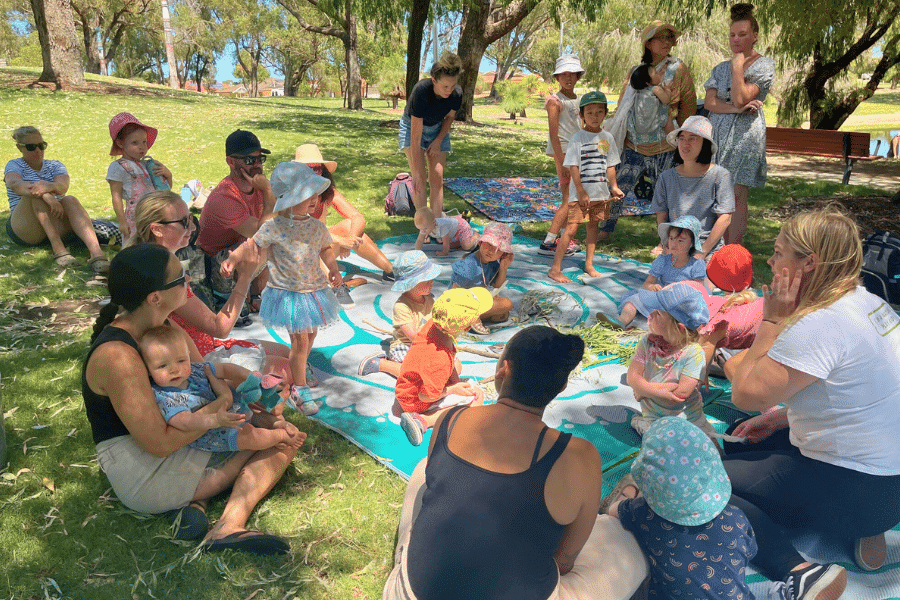
What is Nature Play in the Park?
There are some very simple premises on which this program is based. A playful mindset is one of them. This means bringing a sense of playfulness and responsiveness to our parenting. We adults often focus on safety and efficiency at the expense of exploration and responsiveness. It means we often say things like no, don’t, and be careful, as reflex responses when really, we are trying to avoid things like dirty clothes, time delays and scraped knees – all of which are important and valuable experiences of childhood. Bringing a playful mindset is about being open to exploring experiences with kids and accepting the challenges and benefits that come.
Ideally, when challenges come, rather than trying to avoid and remove them, we would encourage our kids to take the challenge on, possibly be uncomfortable (both them and us), and then enjoy the thrill of accomplishment afterwards. Not all challenges end in a sense of accomplishment, but they all end with the realisation that we are ok, and we can bounce back when things don’t go as hoped. The more opportunities that children get to learn this in small ways, the bigger their bank of resilience will grow, and the sweeter the accomplishments will be when they come.
Outdoor play is the second premise and its value is amplified when combined with a playful mindset, or unsupervised play (for older kids). When kids play outside, they get to move in big ways and take risks that they can’t inside. They can take on physical challenges. They can run as fast as possible, climb things, walk on slippery and uneven surfaces and experience different weather. All these things help to build resilience and confidence – the building blocks to good mental health.
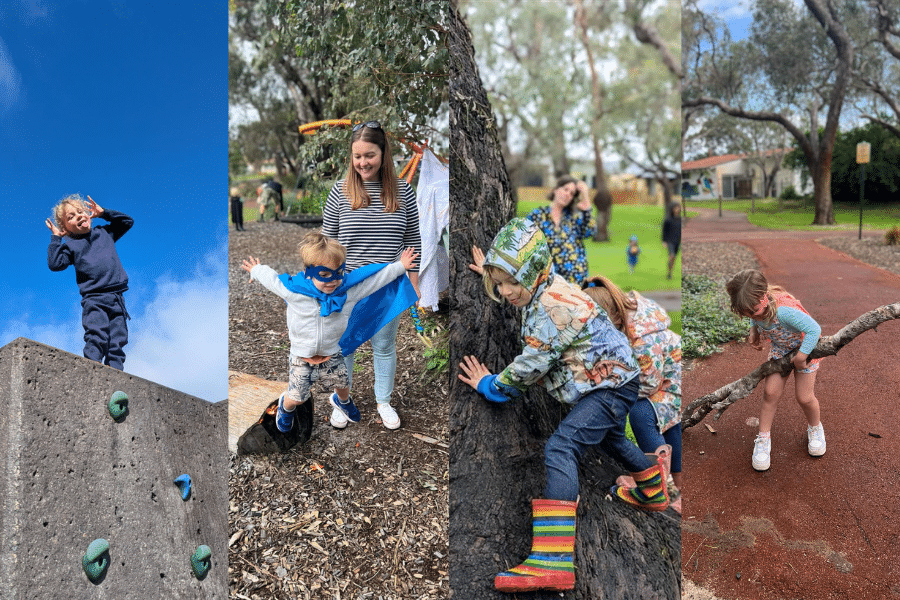
And here’s the hard truth: there are no shortcuts to parenting.
It’s challenging, but so is being a kid. Our children need us—not just to tell them they’re doing great, but to give them the space to face challenges and grow. They need time to play with other kids, opportunities to take risks, and environments where they can be active and carefree. Parks, play, risk-taking, and time with us—this is the recipe for building confidence, resilience, and ultimately, good mental health. And through it all, they need to know we’re there for them, no matter the outcome.
Learn more
Information about hosting Nature Play in the Park is available here for local government representatives. Parents interested in learning more are invited to check out this article – About Nature Play in the Park for Parents.